
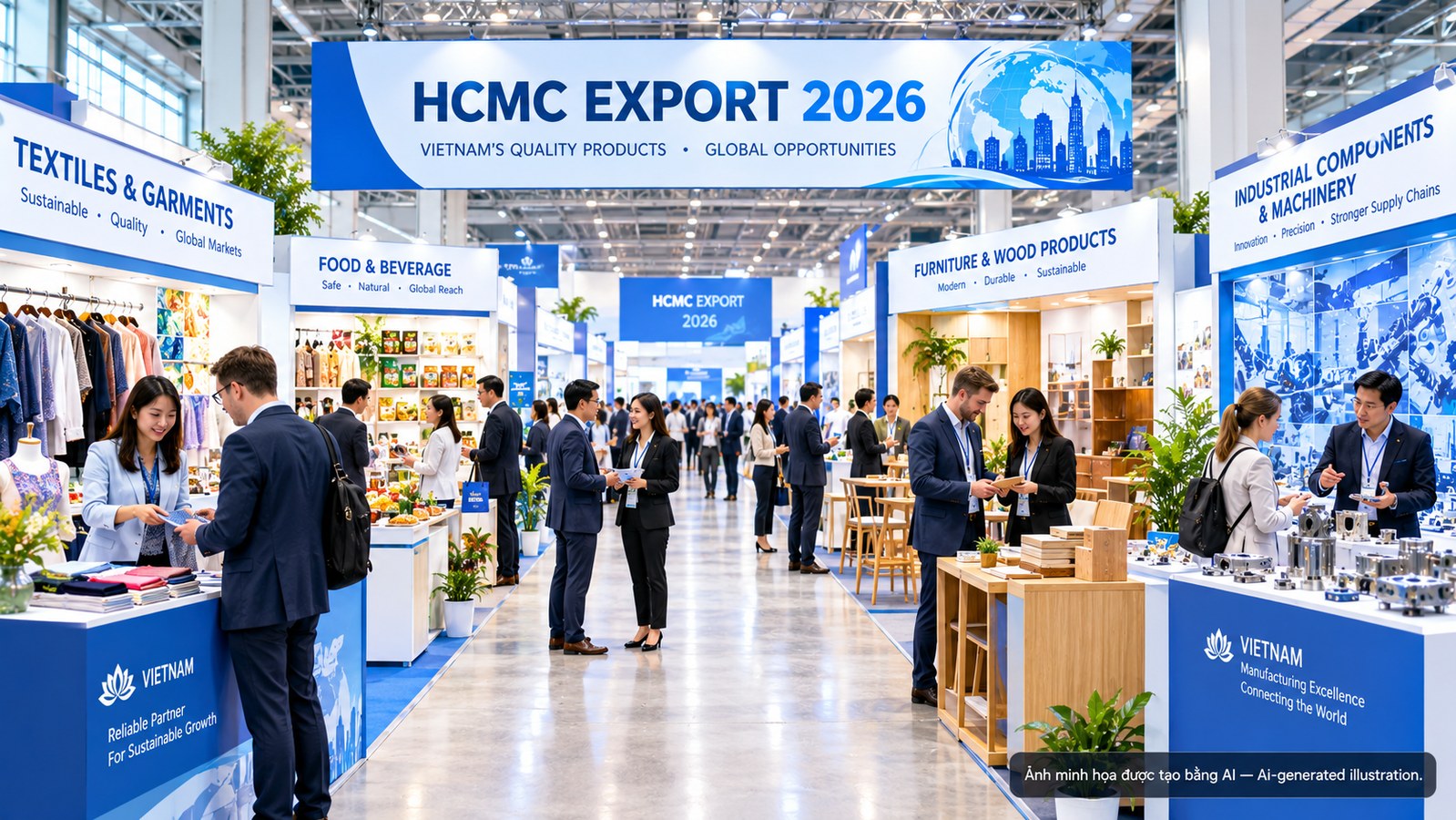
HCMC Export 2026 Connects Vietnamese Manufacturers with International Buyers
Published: October 24, 2026
HCMC Export 2026, Vietnam’s Outstanding Export Products Fair, is taking place from October 22 to 24 at WTC EXPO in Ho Chi Minh City. The event aims to connect Vietnamese manufacturers with international buyers, support market expansion, and help local businesses participate more deeply in global supply chains.
According to Vietnam’s Government News Portal, the fair features approximately 750 booths, with participating businesses from Ho Chi Minh City and seven other provinces and cities: Tay Ninh, Dong Thap, Hue, Khanh Hoa, Dong Nai, Vinh Long, and Ninh Binh.
The event’s official website lists a planned scale of more than 700 Vietnamese exporters, over 400 buyers, and more than 15,000 visitors. These are published event-scale figures, not confirmed counts of contracts or orders secured.
1. What Makes HCMC Export 2026 Relevant to Buyers?
The fair focuses on direct engagement between Vietnamese manufacturers and international buyers.
Instead of relying solely on catalogs or online introductions, manufacturers can display products, discuss technical specifications, explain production capabilities, and meet potential commercial partners.
The event focuses on five main product and service categories:
- Food, beverages, and processed agricultural products.
- Textiles, garments, leather, footwear, and fashion accessories.
- Handicrafts, gifts, wood products, and furniture.
- Household appliances, hardware, and hand tools.
- Export-support services, including logistics, banking, insurance, and e-commerce.
The categories cover both finished consumer goods and sectors that may offer opportunities for material suppliers, contract manufacturers, and export-service providers.
2. What Opportunities May Be Available to Vietnamese Manufacturers?
Reaching new buyers
The fair provides a setting for Vietnamese companies to introduce their products to importers, distributors, and trading partners. These conversations can help suppliers assess whether their offerings match buyers’ actual requirements.
Understanding sourcing requirements
Direct discussions may help manufacturers clarify quality expectations, minimum order quantities, delivery schedules, packaging, certifications, and traceability requirements.
Expanding supplier networks
Manufacturers do not need to focus exclusively on end buyers. They can also explore relationships with exporters, distributors, and businesses sourcing products for specific markets.
Demonstrating supply-chain readiness
A clear presentation of factory capacity, equipment, production processes, and quality-control procedures can help manufacturers demonstrate their ability to meet buyer requirements.
However, exposure is not the same as a commercial result. The number of booths or visitors does not automatically indicate the value of contracts signed, new orders secured, or export growth achieved after the event.
3. On-Site Exporting: Bringing Buyers Closer to Manufacturers
One of the approaches highlighted by event organizers and government representatives is “on-site exporting.”
According to Vietnam’s Government News Portal, the initiative gives international buyers opportunities to visit factories and raw-material areas and assess Vietnamese companies’ production capabilities directly.
This approach can shorten the supplier-evaluation process, particularly when buyers need to inspect product quality, production capacity, manufacturing processes, or delivery capabilities before placing an order.
The event also combines its physical exhibition with online platforms, livestreaming, and cross-border e-commerce to maintain business connections before, during, and after the fair.
This reflects the growing role of multiple channels in trade promotion. Nevertheless, suppliers still need a systematic process for following up with prospective buyers after the event.
4. How Can Manufacturers Turn Meetings into Orders?
For manufacturers seeking export customers, attending a trade fair is only the first step. Converting a meeting into a commercial agreement depends heavily on preparation and follow-up.
First, prepare a professional factory profile.
The profile should clearly describe products, production capacity, equipment, quality-control procedures, existing certifications, lead times, and contact details. All information should be accurate and verifiable.
Second, prepare product samples and technical specifications.
Buyers need to understand which requirements a product meets, what customization is available, how quickly samples can be provided, and whether the manufacturer can support larger production volumes.
Third, define supply capabilities.
Manufacturers should know their minimum order quantities, lead times, packaging options, ability to maintain consistent quality, and acceptable payment terms.
Fourth, follow up after buyer meetings.
Record each prospect’s requirements, send requested documents, prepare relevant quotations, and agree on the next steps. Collecting business cards without a follow-up plan is unlikely to produce meaningful results.
5. Green Manufacturing and Traceability Are Increasingly Relevant
Vietnam’s Government News Portal reports that the fair also promotes green and digital transformation, encouraging businesses to improve product standards and meet requirements related to environmental performance, traceability, and technical regulations in importing markets.
For exporters, this means product quality is not the only factor influencing competitiveness. Buyers may also ask about raw-material origins, quality records, manufacturing transparency, and the ability to comply with market-specific requirements.
Requirements differ by product, destination, and buyer. Manufacturers should identify their target markets and verify applicable requirements before investing in certifications or changing production processes.
6. What Can Companies Do If They Missed the Fair?
The event runs for three days and concludes on October 24, 2026. Companies that did not attend can still use it as a prompt to review their international customer-acquisition strategy.
Practical next steps include:
- Select two or three priority export markets.
- Build a list of relevant importers and distributors.
- Prepare a clear factory profile in English.
- Organize product samples, technical specifications, and export quotations.
- Establish a follow-up process to track prospects and measure the performance of each sourcing channel.
Manufacturers should also monitor upcoming trade-promotion and business-matching programs announced by government agencies, industry associations, and event organizers.
Conclusion
HCMC Export 2026 highlights continued efforts to connect Vietnamese manufacturers with international buyers. The event’s published scale includes approximately 750 booths and companies representing a range of export-oriented industries.
For manufacturers, success depends on more than exhibiting products. Suppliers need to demonstrate production capabilities, meet buyer requirements, and maintain relationships after the initial meeting.
To turn trade promotion into business results, manufacturers should prepare credible factory profiles, products that meet relevant standards, and a structured process for managing buyer relationships.
Sources:
- Vietnam Government News Portal, “Vietnam’s Outstanding Export Products Fair 2026 Opens,” October 22, 2026.
- Official HCMC Export 2026 website, event information, exhibitor categories, and buyer-connection program.
VietnamFactoryData.com — Connecting global buyers with Vietnam’s manufacturing capabilities.